

 Subscribe
The Art of War
January 26, 2009

I have finally gotten around to enrolling in the hand-to-hand combat class known as Modern Army Combatives or just Combatives. In the past I have avoided this class like the plague. The core elements of the class are ground fighting/grappling techniques. If you have ever watched UFC on TV, the class teaches you the same techniques and skills. As a boxer it is completely unnaturual for me to find myself wrestling on the ground.
After day one, I can say I have found a new respect for the class. Today I spent basically 8 hours getting my ass kicked. I have found myself sitting in front of the computer, completely dehydrated, sore from head to toe; I am drinking glass after glass of water and doping up on Bayer.
The morning started with the 14 of us learning Combatives Drill One. This included achieving a dominate position over your party/enemy, whether this is to be on top of your foe or to achieve a position that leaves your counterpart with their back to you. Next we learned to escape your foes dominate position and place yourself back in a dominate position. We drilled this over and over, at a slow speed so everyone could learn each of the steps. I can tell you, it was incredibly repetitive and became very boring. But, with everything in the military and in life in gerneral, you must crawl before you walk and you damn well better walk before you run.
After breaking for a brief lunch, we returned. We continued to learn a few submission moves to include arms bars and chokes. Once we ran through those for the next we moved on to our run stage. First we grappled one versus one to achieve the dominate position, next moving to one versus one to achieve submission. From their we moved on to a drill known as the bull ring. Here, you fought everyone in the class. If you found yourself the “bull” every member of the class would grapple with you one after another with no rest in between. Just as you thought you were done with one person, another would be shooting in to achieve a dominant position and ultimately make you submit.
I must state it was definately a brutal day. I am excited, but at the same time cringe when I realize that this is only day one and their are four more days of progressivly harder drills. I will continue to keep you posted on the outcome of the days. For now I leave you with the history of the Modern Army Combatives Program (MAC-P). Read more
Planting The Seeds Of Stability
January 25, 2009
When a National Guard unit deploys to a war torn country, they take with them, not only the skill set they were trained on in the military, but the often varied experiences and expertise from their civilian job as well. Some may be businessmen, students, doctors or nurses, lawyers or even farmers. The things that these Soldiers can bring to the table during a deployment, are often as varied as the personality of each Soldier. Members of agricultural development teams currently deployed to Afghanistan, are shining examples of what the National Guard stands for. Their emblem alone signifies this: A minuteman holding a musket in one hand and the other hand resting on a plow. At a recent media roundtable event, Secretary of the Army Pete Geren and Army National Guard Chief,Lt. Gen. Clyde Vaughn, spoke about the capabilities that these Soldiers bring to the development of the countries that they are deployed in. Joining them for the event via video teleconference was Army Col. Stan Poe, who is currently in Afghanistan leading a team from Texas National Guard, and Sultan Huessen Abasyar, who is the director of Ghanizi provinces agriculture, irrigation and livestock office.
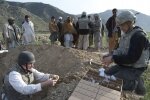
U.S. Department of Agriculture and Konar Provincial Reconstruction Team members conduct bulk density soil samples in Marawara District, Afghanistan. Photo By: U.S. Navy Lt. j.g. James Dietle
According to data that the men provided, about 85 percent of the population in Afghanistan is involved in agriculture. The deployed teams are working on what the country needs to better support their citizens who are engaged in agriculture, as a means of support.
“For the US Army to consider having teams like the agribusiness development teams … concerned only with agriculture and advancement of improving agriculture in Afghanistan - is in my opinion one of the best ways to not only help the people of Afghanistan improve their economy and living standards, but to help Afghanistan prosper as a nation for future generations,” Sultan Abasyar said through an interpreter.1
The team from Texas, is composed of 58 members. 10 of those members are experts in various farm related disciplines. Their job is to assist the Afghan farmers with various tasks. Those tasks might involve things such as seeds, fertilizers, irrigation projects, electricity and social analysis. The remaining members of the team are National Guard Infantrymen. However, every single member of the team has a farming background. While their main job is be a security force for the team, each of them are knowledgeable in farming and how to get crops into the ground and then harvest them. As is evidenced by the rebuilding projects in Iraq, our Troops aren’t in the country, just to fight, but also to help the country move past the war, rebuild their country and stabilize the country and it’s economy. Each National Guard Soldier in the team is able to bring with them, the expertise of their civilian jobs.
Each of the teams have ties with universities and organizations in the United States, in order to help them best serve the Afghan population that they are working with. For example, the Texas team is in constant contact with subject matter experts at Texas A & M University. The staff at Texas A & M is able to assist the teams with soil analysis and provide suggestions for what crops might do well in that particular soil and climate.
“Water is the limiting factor in Ghazni,” Vaughn said. ” A lack of water is not the problem in Afghanistan,” he continued. “The management of the water is the problem.”2
The teams have worked on several projects with the Afghan farmers. They have assisted by putting in dams on mountain streams. This helps to lengthen the growing season by a month. Other projects include water management techniques, to help prevent floods and control erosion of the soil, micro-generators for the farms and installing windmills and solar powered collectors, to enable the farmers to have the electricity they need to operate their farms more efficiently.
Another project the team is exploring is creating jobs in the region by helping to create industries that will utilize raw materials that come from the farming industry. Members are working with local government officials on putting in a feedlot for cattle. More things than meat can be taken from the cattle industry. Because of this fact, the teams are working to construct a building to house a place for butchers to slaughter the animals that come from the feedlot. They are also working on a tanning facility, that can tan the hides of the animals and make leather. They are also looking at creating cold storage facilities and possibly a wool washing factory. Each new facility that is opened, strengthens the farming industry as well as create jobs for the people of the region. With jobs available, it’s hoped that the citizens will be less likely to align themselves with the Taliban. This in turn makes their communities a much safer place for them to live and raise their families in.
They new projects are many and very exciting to the citizens of the region. These projects will make Afghanistan a much safer, more productive and a more stable place for it’s citizens. Due to the stability the country has experienced over many many years, the country basically lost an entire generation of farmers. Recognizing this, the teams are working with officials from Afghanistan, as well as officials from Texas A & M, to create schools to train teachers and provide materials, that can be used to educate current and future generations of farmers in Afghanistan.
By using the expertise of Soldiers such as the team from Texas and another from Missouri, the Army is tapping into a very important resource. By using Soldiers from the states where agriculture is one of the primary industries, the Army is able to provide a very valuable and much needed service to the people of Afghanistan.
“This is what we need for long-term solutions in Afghanistan,” Vaughn said. “This is a poor country and if we can improve the way they farm, we are making a huge contribution to stability in the nation.”3
This is a wonderful service that our Troops are providing to the citizens of Afghanistan. I think it’s great that the Army is tapping into the expertise of their National Guard Soldiers and putting that expertise to work in a way that will not only strengthen the economy and stability of Afghanistan, but forge a strong bond with the people, by helping to improve their living conditions and creating jobs.
- http://www.army.mil/-news/2009/01/22/16001-national-guard-farmers-planting-long-term-afghan-stability/ [↩]
- http://www.army.mil/-news/2009/01/22/16001-national-guard-farmers-planting-long-term-afghan-stability/ [↩]
- http://www.army.mil/-news/2009/01/22/16001-national-guard-farmers-planting-long-term-afghan-stability/ [↩]
Creating Hope For The Future
January 18, 2009
Children in the United States have always had the opportunity to attend school and obtain an education, in order to prepare themselves to enter the job market and make a living for themselves and their families. Many go on after completing High School, to college to learn a trade in order to better compete in the job market. In war torn countries such as Iraq, Afghanistan, Kosovo and others, the children often don’t have the opportunity to attend school, for many reasons. Sometimes, because their families need them to earn wages, in order to help provide sustenance and shelter for their family members. Other reason might be because of the dangers involved with going to school, or the fact that the building their school was held in, was damaged during fighting. Our children are very lucky that education is a top priority in our country and every child is required to attend school, at least until they reach the age of 16, at which time they have the choice to drop out, get their GED or complete their High School education. Often in other countries, while the children yearn to attend school, many reasons prevent them from doing so. Knowing the importance of education for the future of these countries, one thing provincial reconstruction teams have concentrated on, is ensuring that the children in these countries have the opportunity to obtain an education.
Recently, in one Afghan province, commitment to education was at the forefront, during a ground-breaking ceremony for the Maliki Surial girls’ school in the province’s Behsood district Jan. 11. When completed, the school will have 10 classrooms which will allow for 1,400 girls to attend school within a year.
“Currently, the girls attend an open-air school where they sit outdoors and learn,” Army Capt. Elisabeth Leon, Nangarhar PRT lead engineer, said. “When the weather turns bad, they simply can’t go to school.”1
During the groundbreaking ceremony, officials urged those in the audience to do everything possible to make sure that the school reaches it’s potential. By ensuring that the school succeeds, they are also ensuring that the girls who attend the school, have the opportunity to succeed, far beyond their wildest dreams. They will be giving each of the young girls hope for their futures.
“The key to success in Afghanistan is education of all children,” LTC Steven Cabosky, Nangarhar PRT commandersaid. “While this school project will help, the hard work still exists. It’s up to all of you to make sure your children are able to go to school and receive an education. That is what will build a strong Afghanistan.”2
Before the Taliban government was defeated in 2001, fewer than a million children – almost none of them girls — attended school in Afghanistan. Since then, the number has grown to more than 6 million children, with 35 percent of them girls, according to NATO International Security Assistance Force statistics.3
With each new school that is built, or one that is refurbished, more chance for success and change is offered to the future of these countries. These children are the future leaders of their country. With the chance to obtain an education, they are being enabled to succeed and make positive changes in their country. This provides hope for their future and the future of their country.
- http://www.defenselink.mil/news/newsarticle.aspx?id=52689 [↩]
- http://www.defenselink.mil/news/newsarticle.aspx?id=52689 [↩]
- http://www.defenselink.mil/news/newsarticle.aspx?id=52689 [↩]
Radio Station Brings News To Villages
October 1, 2008
Imagine living in a remote village in Afghanistan, where obtaining news from the outside world was almost impossible. In many of the villages, they are so remote, that conditions are primitive at best. People are often isolated and cut-off from the rest of the world.
For we Americans, who are used to having the luxury of our radios, televisions, newpapers and telephones just a fingertip away, it’s hard to imagine what life must be like for the people living in those villages. I know for myself, I would feel very isolated and out of touch with the world.
Sarwar and Islamuddin, the Bermel Radio station jockeys, located on Forward Operating Base Boris, Paktika province, broadcast religious services, play music, educational programs and spread news 13 hours a day to the local area.
In Afghanistan, citizens are now able to have more of an idea what’s occurring in the world, with the opening of a new radio station, “The People’s Radio, located at 92 FM on their radio dial. The creation of the radio station was done with the idea of providing news, advice and education to the villagers. Currently the station, located at Forward Operating Base Boris operates 13 hours per day, throughout the district of Bermel, which is located in eastern Paktika province.
Currently the station is providing over 11 different types of programs. They cover almost every aspect of life for the people in the local villages. The programs range from work and agriculture to health and education. The station also features programs that are specific to women, as well as religious service programs.2
Operating the station are Sarwar, who is a former agricultural professor at Khowst University and Islamuddin, who is an advisor that has over 10 years of agricultural experience. The operate the station as well as host most of the broadcasts.
“We try to do as much as we can for the people here,” Sawar said. “We even meet with them and teach them as much as we can about agriculture. It’s a big part of life for them and we want to make it better for them.”3
So far, the local villagers have responded favorably to the new radio station and the information that it provides to them. The radio station has been in operation for 5 months and thus far have received over 7,000 letters from citizens. Most of the feedback has been positive. Letters run the gamut from offering praise, to making suggestions, asking questions or requesting other programming. The response from the citizens has been so good, that plans are in the works to expand the station. Currently it is operating on a 50 watt system, which has a listening range of 15000-17000sq km. Plans are to upgrade that to a 500 watt system, which will increase the listening range over 10 times to what it is currently, or closer to 170,000 sq. km.
Funding and support for the radio station are provided by Internatinal Security Assistance Forces, which also assists the operations of 9 other radio stations in the Paktika province. It’s great to see these positive steps being taken in Afghanistan. Just knowing what has been accomplished in Iraq and the improvements that have been made, gives me hope that we’ll begin seeing many similar changes in Afghanistan as well, including more radio and television stations, to ensure that those in isolated regions of the country can have contact with the rest of the world, if that is their choice.
- www.centcom.mil/en/news/bermel-radio-sends-information-to-villages.html [↩]
- www.centcom.mil/en/news/bermel-radio-sends-information-to-villages.html [↩]
- www.centcom.mil/en/news/bermel-radio-sends-information-to-villages.html [↩]
Helping Iraqis Bring Their Country Into The 21st Century
August 15, 2008
One mission, besides security, that our Troops have spent a lot of time on Iraq and are very dedicated to, is helping to rebuild the country’s infrastructure and update facilities and equipment. Technologically speaking, Iraq is about 25 years behind the rest of the world, mostly in part, because of the fact that for 25 years, under the reign of Saddam Hussein’s regime, they weren’t allowed the technological advances that the rest of the world enjoyed. Hussein and his regime, kept the country in the “dark ages” so to speak, not allowing citizens access to modern conveniences, things that for us, are commonplace.
“You’re looking at a nation that has … suffered from 25 years of tyranny under Saddam Hussein and has not had the things that you and I take for granted,” Air force Col. Karlton Johnson, communications director for the Multinational Security Transition command in Iraq told online journalists and bloggers in a teleconference.1
For instance, much of Iraq was without electricity for much of each day, before the 2004 invasion of the country, so the things that we enjoy, such as televisions, dvd players, computers, etc weren’t able to be used for much of the time. Modern sewer and water filtration systems are another thing that our Troops have been working on. As our Troops made their way into Iraq, the stench of sewage in the streets was often overpowering.
“What we intend to do over the next 500 days is to take the Iraqis from where they are to the next level,” he said.2
That process isn’t an easy one, as the entire backbone of the country, electrical services, water services, etc are so far behind, that those have to be updated prior to updating other things, such as computer networks. The initial plans are to upgrade the government security, communications systems, to support the country’s security functions. Experts in all fields are focusing on mentoring and building relationships with their Iraqi counterparts. Because their needs are different than those in the US and Europe, it’s imperative that those officials are involved in the process. The hopes are, that even though the focus at this point is on the technological capabilities of the government, that will eventually filter down to the citizens. Col. Johnson recalled an incident, where he wanted to loan a CD to an Iraqi friend, only to find out that his friend did not own a CD player.
“When I look at what we’re providing in terms of education, mentorship and training to senior Iraqi leadership,” he explained, “I always have in the back of my mind; ‘This is something that’s got to permeate down to those people who, like this one individual, don’t have things like computers, don’t have things like the Internet.3
Johnson did mention that he feels it will take many years to bring Iraqi up to date and into the 21st Century. However, the things our Troops are doing, will go along way towards helping them advance technologically. Without that help, they might have still remained 25 years behind, without the things that we as American see as necessities, things they never had the opportunity to have.
- http://www.defenselink.mil/news/newsarticle.aspx?id=50805 [↩]
- http://www.defenselink.mil/news/newsarticle.aspx?id=50805 [↩]
- http://www.defenselink.mil/news/newsarticle.aspx?id=50805 [↩]
Water Distribution Site Opens In Iraq
August 6, 2008
One of the things that has been constant in Iraq is the lack of running water. Citizens in Iraq have often had to trek to community wells to obtain the water that they would need for the day. With the threat of implanted IEDs, that’s not always been the safest thing for the citizens to do.
As of August 3rd, more than 500,000 Iraqis will have purified water available to them, thanks to the joint effort of the Baghdad Water Authority, Iraqi leaders and leaders from the 4th Brigade Combat Team, 10th Mountain Division, Multi-National Division. Once the site was opened, trucks from the Baghdad Water Authority filled their trucks, so that they could deliver the purified water to the residents. The project began late last April and it established three water distribution sites, to better serve the residents.1
For us, water is something that we take for granted. It’s nothing for us to turn on the tap and have fresh, purified water at our disposal. It’s nothing for us to allow our children to play in the water sprinkler in our backyards. We tend to get a little bit cranky if our water isn’t flowing as expected. We’ve never had to do without it.
According to “Sam,” an engineer and bilingual, bicultural advisor working with 4th Brigade Combat Team, 10th Mountain Division, when the site is fully functional and operational, there will be at least 10 Baghdad Water Authority trucks, each containing 12,000 to 15,000 liters of purified water, that will be delivering to the neighborhoods on a daily basis. Initially, the site is expected to service approximately 500,000 citizens and has the potential to double that amount.2
“We are going to double our capacity for the future, and we are going to get over a million people to [receive] distributed water,” said Sam.
I’m sure that with the temperatures reaching well over 100 degrees daily in Iraq, that having fresh purified water is something that is welcomed by the citizens that the distribution plants will be serving. This is just another thing that shows the efforts that are being made to rebuild the country of Iraq and make things better for the citizens, than they were before the war began.
- http://www.mnf-iraq.com/index.php?option=com_content&task=view&id=21643&Itemid=1 [↩]
- http://www.mnf-iraq.com/index.php?option=com_content&task=view&id=21643&Itemid=1 [↩]
- http://www.mnf-iraq.com/index.php?option=com_content&task=view&id=21643&Itemid=1 [↩]
Em’Powering’ Iraq
July 24, 2008
One of the things that Coalition Troops and the Iraqi government having been working hard on is to restore power and other utilities to the citizens of Iraq. Many citizens have had limited power, since before the war in Iraq, when Saddam made sure that he and his cronies had an unending supply, yet the people had limited or no power. New power generation plants have been built, like the one in southern Baghdad in 2006. With the new technology comes the need for trained personnel to operate those plants.
Recently, students from the Ministry of Electricity in Iraq were at the plant in southern Baghdad to be trained in operation and management of electrical power plants. Since February, over 1000 students have been trained, in what used to be an old dining facility. The plans had been to dismantle the camp near the competed electricity facility, when one of the program managers came up with the idea that it would be a great place for a training facility.
“The GRD was in the process of dismantling a man camp of trailers at a completed electricity project in southern Iraq,” said Vincent Dorio, GRD electrical sector program manager. “Then one of our high speed contractors came up with the idea of using the old DFAC (Dining Facility) and some other trailer bits and pieces laying around camp to fabricate the parts into a training facility for Baghdad South. We worked together to design and reconfigure the trailers into a MoE school house and of course transport the unassembled pieces 300 miles north to Baghdad.”1
With the creation of the training facility, this guarantees that there will be fully trained workers to operate the electrical plants across the country. The school will be open to people from across Iraq. This ensures jobs for the citizens, as well as ensuring that trained personnel will be on hand to work on the new electrical power plants should problems arise and repairs need to be made. As with most facilities of this type, there does come a time, when machinery breaks down or preventative maintenance needs to be performed. This is great news for the citizens of Iraq and will ensure that they will have power in their homes and the people trained to ensure that they continue to have power. More and more training facilities of different kinds are being opened across Iraq to ensure that workers have the capability to work in their chosen field and provide a quality service to the people. We’d expect nothing less here in the United States and our Troops are ensuring that the Iraqi people receive no less.
These are the types of things that aren’t ever reported in the media. It’s not often that the media tells us about the successful completion of such projects. Instead, to find out what’s really happening, you’ve got to either search for it amongst the many government websites or hope that one of the MilBlogs report the information. That’s one thing that we strive to do here and will continue to do.
- news/releases/NR08-07-12-02.pdf [↩]
Summer Fun In Baghdad
July 6, 2008
Summertime will be here soon. Already here in Texas, the temperatures are staying around 95 most of the time. For our children, one of their favorite things to do, is to head to the local swimming pool or lake and get some relief frm the heat. This time of year in Iraq, the temperatures are soaring over 100 Degrees. In Itraq, that desire to “beat the heat” isn’t any different than it is here. On Saturday, in a sign that things are beginning to return to normal, the public swimming pool in Zawra park reopened. Children and adults plunged into the cool blue waters of the pool, as US Soldiers stood guard nearby. The pool has been closed since before the March 2003 invation. The pool has been rebuilt and is now open for business.
“It’s just great, I am very happy,” said 11 year old Muntawar, jumping into the water with his clothes on. His sisters joined him, screaming in
joy, as their mother watched from a shaded spot nearby. “This is the first time I have come to this pool, but I will come again and again with my friends,” he said.
The park is located close to the Green Zone and also includes a zoo. With the reopening, there are likely to also be more picnickers. The zoo which was once famous for it’s tigers, now shelters a few animals and birds. As things are added or renovated, more and more citizens of Baghdad will begin venturing out to the park once again.
“We are so happy. This pool is for all Baghdadis and Iraqis. All Iraqis when they come to baghdad can come here,” said a smiling Yahya Mohammed Ali, deputy mayor of Baghdad who attended the reopening ceremony. “It is a sign that peace is returning, he said, also stating that the pool and park were now safe.
This is just one more thing that the US military is doing to improve public places, which will go far in winning over the hearts and minds of the citizens of Iraq. Renovation and improvement of public utilities and places have been strongly promoted by General David Petraeus, in his counter-insurgency plan.
As new improvements are made and new businesses are opened, we’ll make sure to share that information with our readers here at A Soldier’s Mind. These things are signs that the surge is working and clearly point to the fact that it’s imperative that our Troops are allowed to finish their jobs in the country. These things also make our Troops more determined to continue the work that they’re doing.
Students at Village of Hope Keep Canals Flowing
July 3, 2008
Students of the Village of Hope help clean an irrigation canal near Hawr Rajab, Iraq, June 26, 2008. The students learn construction skills and repair damaged buildings in the program, and also help keep their community clean.
In March I wrote a story about the Village of Hope Vocational Technical school in Hawr Rajab, Iraq and how it was flourishing in the village and helping to teach technical skills to the area students. The residents are beginning to see the successes of the school, as it benefits them. On June 26th, students of the Village of Hope began cleaning irrigation canals in the area, in an concerted effort to improve the flow of fresh water to farms in the region.
Village of Hope students were asked to assist the community with maintenance of the canals. That involved helping to keep them clean, a task that is necessary to keep the water flowing. By doing this, they are not only receiving on the job training skills, but they are also working to benefit the communities that they live in.
“The benefit is for the agricultural community,” explained Air Force Capt Michael Askegren, officer in charge of the Village of Hope program. “This is a rural community that relies heavily on agriculture and farming industries. By cleaning out the canals, they are helping to make sure that the water flowing to the fields is going to be good.”
Currently there are over 200 students enrolled at Village of Hope. The students do work at community projects similar to cleaning the canals, while waiting for their turn in a classroom rotation. In the area, employment outside of farming is often scarce. By attending the Village of Hope, the students are learning new job skills, thus creating income sources. Many of the students are members of the Sons of Iraq. Askegren estimated that only about 1/3 of them would be able to get jobs with Iraqi security forces, so it’s imperative that they learn new job skills, in order to maintain employment and support their families. Other projects have been lined up for students, such as renovating homes and taking part in larger construction projects … all projects that will provide them with training in different job skills. Village of Hope instructors work closely with officials on the Hawr Rajab town council to determine which projects are needed the most.
“We got the second task order awarded on June 26th for students to continue to work downtown, and we’re already working on the next project, which will be the renovation of the Alma-an Boys School. We hope to have that contract awarded as soon as next week,” Askegren said. “We’re definitely moving into the full swing, as far as getting construction going downtown.”
According to Askegren, the Village of Hope is funded until the end of September. He does however, expect that funding will continue into 2009. Hopefully, it will continue, well beyond 209, so that it can continue to offer new job skills and hope to the younger generation of Iraqis in the Hawr Rajab region.
Creating Jobs Imperative In Iraq
July 1, 2008
We’ve covered the creation of new jobs in Iraq several times here at A Soldier’s Mind. For the citizens of Iraq, just as here in the United States, it’s important for jobs to be available, so that the people can earn a living and support their families. Because of the war in Iraq, many jobs went away, or people were too afraid to go to work, due to threats and violence on the part of the insurgents.
Iraq’s government has launched programs all across the country, to create jobs for the citizens. It’s important that they continue to do so. If there aren’t jobs, then the current stability that has recently been seen in the country, will vanish. Many jobs have been created, with the aid of different micro grants and other programs supported by US Troops. By creating jobs, the Iraqi economy will be revived.
As many as 4,000 people per day are being hired in Baghdad, to help with reconstruction, cleaning the streets, painting and other jobs. Workers are paid a daily rate to do these jobs. Other areas of Iraq have similar programs, though the numbers aren’t as great as they are in Baghdad. The national government is offering various job training programs around the country, to help people learn new job skills. Unemployment benefits are also being paid to some of the jobless.
Some people who have job skills, such as teachers are currently working in various labor jobs, as many of the schools are still being rebuilt. One of those teachers, Hazim Kadim is currently working as a street cleaner in Baghdad, though he longs to get back to his true calling …. teaching.
“I want to work a real job, a job that is in my profession,” he said. “These jobs, they are very little.”
Currently, it is estimated that the unemployment rate in Iraq is between 35 and 50 %. The high rates of unemployment have been thought to feed the outbreaks of violence across the country. When Saddam Hussein’s army was disbanded, thousands of his Soldiers were left without jobs. Many went on to band with the insurgency. Others, looking for work are going to work for the US led coalition and other foreign agencies, often at great risk. The insurgents have long targeted those who work with and for the coalition.
Iraqi Prime Minister Nouri al-Maliki has begun a major push to increase trade ties and attract investment from neighbors like Turkey. But investment is coming in only slowly and sporadically, even in key industries like oil, for which a law meant to pave the way for investment is still hung up in parliament. Not all of the unemployment problems in Iraq, stem from the war though.
Prior to the war, the economy was state controlled. That discouraged private entrepreneurship and outside investment. Because of the sanctions against the Saddam era government, that withheld current technology from the country, for improvements and repairs to government operated power stations and factories.
Slowly, things are beginning to improve in Iraq. As new jobs are created, more people will be able to return to work and support their families. Hopefully, for most, the new jobs will come in time and the citizens of Iraq can continue to rebuild their country and their lives.
Next Page »
Advertisement
|
|
-
Recent Posts
- Is It Really Possible To Eliminate Sexual Assault In The Army?
- Remembering Those Who Sacrificed Their Lives On D-Day
- Swapping Stories Of War
- Boot Camp 101
- Working To Defeat Combat Stress
- Faces Of Freedom: Remembering Warriors Of The Past
- Memorial Day … A Time To Honor The Fallen
- Warrior Legacy Foundation Launches Memorial Day 2009

